
Bioelectrical Impedance Analysis
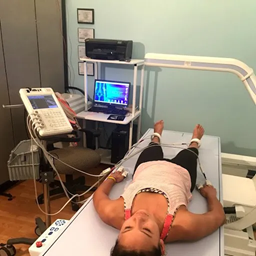
Body composition and segmental lean/fat mass via safe, low-level electrical currents.
What is bioelectrical impedance analysis?
Bioelectrical impedance analysis (BIA) passes a safe, imperceptible low-level electrical current through the body and measures how that current is impeded as it travels through different tissues. Fat is a poor conductor; lean tissue and water — rich in electrolytes — conduct readily. By measuring the opposition to current (impedance) at multiple frequencies, the system estimates the volume of the body’s major fluid compartments and, from those, derives fat mass, lean mass, and a suite of metabolic indices in under five minutes — no radiation, no special preparation beyond normal hydration.
Modern research-grade BIA goes well beyond simple fat percentage. Multi-frequency and bioimpedance spectroscopy (BIS) systems sweep hundreds of frequencies simultaneously — from 1 kHz to over 1,000 kHz — using Cole–Cole modeling to separate intracellular from extracellular water with high precision. The BCL operates flagship systems from both Tanita and InBody, covering the full range from clinical screening to research-grade multicompartment modeling, alongside additional BIS devices used in comparative and validation studies.
BIA served as one of the core modalities in the Shepherd Lab’s Da Kine Study (University of Hawaiʻi, in collaboration with Pennington Biomedical Research Center and the University of Wisconsin–Madison) — a head-to-head comparison of every major body-composition method against the five-compartment criterion model in collegiate athletes — and in the development of a novel 3DO + BIA multicompartment model that replaces costly isotope dilution with accessible field measures.
Major measures and clinical indices
Total body fat % and Fat Mass. Impedance at 50 kHz, combined with participant height, weight, age, and sex, predicts total fat mass and fat percentage using validated population equations. BIA fat percentage agrees closely with DXA across normally hydrated populations and is a practical, high-throughput option for large cohort studies and repeated-measures monitoring. The InBody S10 (supine, octapolar) and InBody 770 (standing) systems used at the BCL have both been validated against the four-compartment model, with excellent agreement across diverse race and ethnicity groups. Cataldi D, Bennett JP, Quon BK, Liu YE, Heymsfield SB, Kelly T, Shepherd JA. Agreement and precision of deuterium dilution for total body water and multicompartment body composition assessment in collegiate athletes. J Nutr. 2022;152:2048–2059. doi:10.1093/jn/nxac116
Fat-Free Mass (FFM) and Skeletal Muscle Mass (SMM). Fat-free mass is computed from impedance-derived total body water and established assumptions about the hydration fraction of lean tissue. The InBody and Tanita flagship systems also report segmental skeletal muscle mass by limb and trunk, providing a lean-mass profile comparable in structure (though lower in precision) to DXA regional output. Segmental lean mass from octapolar BIA is a practical and widely used alternative for sarcopenia screening in settings where DXA is not available.
Total Body Water (TBW) and Intracellular Water (ICW). BIA and BIS systems estimate total body water from impedance directly. Multifrequency and spectroscopy systems additionally separate TBW into its intracellular (ICW) and extracellular (ECW) fractions. TBW is the foundational measurement from which all BIA-derived body-composition outputs flow: the Shepherd Lab’s validation work demonstrated that even small differences in TBW estimation translate to meaningful differences in two-compartment fat and lean models, and that five-compartment models partially mitigate this sensitivity. Cataldi D, Bennett JP, Quon BK, Liu YE, Heymsfield SB, Kelly T, Shepherd JA. J Nutr. 2022;152:2048–2059. doi:10.1093/jn/nxac116
ECW/TBW ratio — BIA’s most clinically unique output. The ratio of extracellular water to total body water is a measure no other body-composition method provides, and it is one of BIA’s most important clinical contributions. In a healthy, normally nourished adult, roughly 60% of body water is intracellular and 40% extracellular, giving a normal ECW/TBW of approximately 0.38–0.40. When this ratio rises, it signals a shift of fluid out of cells — which occurs in malnutrition, inflammation, edema, cancer, renal disease, and advanced sarcopenia. An elevated ECW/TBW indicates that lean mass is being lost from the intracellular compartment, even when total body weight or simple fat-free mass estimates appear stable. In cancer patients with sarcopenia, a high ECW/TBW ratio is an independent predictor of reduced overall survival, making it a clinically actionable marker of physiological stress that is invisible to DXA or the Bod Pod. Bioimpedance spectroscopy (ImpediMed SFB7 / SOZO) systems at the BCL measure ECW/TBW directly via Cole–Cole modeling.
Phase Angle (PhA). Phase angle is the arctangent of the reactance-to-resistance ratio and is a direct measure of cell-membrane integrity and capacitance, independent of any assumed body-composition model. High phase angle reflects intact, well-hydrated, metabolically active cells; low phase angle indicates cell-membrane compromise from malnutrition, disease, aging, or overtraining. Phase angle is emerging as one of the strongest single-number prognostic biomarkers in oncology, critical care, and sports nutrition, and it is available from every multi-frequency BIA measurement without any additional computation.
Segmental fluid distribution. Octapolar systems (eight-electrode configurations) at the BCL divide the body into five segments — right arm, left arm, trunk, right leg, left leg — and report impedance, lean mass, fat mass, and fluid volumes independently for each. Segmental fluid analysis is clinically valuable for detecting unilateral edema (including lymphedema after breast-cancer surgery), asymmetric muscle development, and regional fluid shifts from injury or treatment.
3DO + BIA multicompartment model. A 2024 Shepherd Lab innovation combined 3D optical imaging (for body volume) with BIA (for total body water) and DXA-derived bone mineral from a demographic prediction to construct an accessible five-compartment body-composition model requiring no isotope dilution. Validated against the Wang five-compartment criterion, this hybrid approach brings research-grade body-composition precision within reach of any setting that has a 3DO scanner and a BIA device, and it is now used in Shape Up! Adults and related studies. Bennett JP, Cataldi D, Liu YE, Kelly NN, Quon BK, Schoeller DA, Kelly T, Heymsfield SB, Shepherd JA. Development and validation of a rapid multicompartment body composition model using 3D optical imaging and bioelectrical impedance analysis. Clin Nutr. 2024;43:346–356. doi:10.1016/j.clnu.2023.12.009
Hardware at the BCL
Tanita — flagship segmental BIA. Tanita’s professional-grade multi-frequency segmental analyzer uses eight-electrode hand-foot contact technology and proprietary algorithms validated across diverse populations. The system produces a complete segmental body-composition report — total and regional fat mass, lean mass, estimated bone mass, visceral fat level, basal metabolic rate, and body-water percentage — in a single standing measurement. Tanita systems are widely used in epidemiological and clinical research for their throughput, standing-position measurement, and established reference databases.
InBody — research-grade multi-frequency BIA. InBody flagship systems (S10 supine and 770 standing) are octapolar multi-frequency analyzers that measure impedance at six frequencies per segment and report segmental fat, lean, and fluid compartments with high reproducibility. The S10 supine configuration, used in the Shepherd Lab’s Da Kine Study validation, is particularly valuable for participants who cannot stand, for post-exercise or post-intervention serial measurements requiring positional consistency, and for research protocols requiring close correspondence to supine DXA positioning. InBody systems also report ECW/TBW ratio and intracellular water per segment, making them among the most data-rich BIA platforms available.
How should I prepare for a BIA assessment?
- Avoid heavy exercise for 12–24 hours before the assessment.
- Avoid eating a large meal before testing; when possible, avoid food for about 2–3 hours prior.
- Arrive normally hydrated. Do not intentionally dehydrate or overhydrate.
- Avoid alcohol for 24 hours before the test.
- Avoid large amounts of caffeine right before testing, because it may affect hydration.
- Use the restroom before the assessment.
- If you have a pacemaker, implanted defibrillator, or other implanted electronic medical device, you will be excluded from this assessment.
What can I expect?
You’ll either stand or sit for approximately 10 minutes while electrodes attach to ankles and thumbs/middle fingers. The actual measurement takes about one minute. Afterward you receive a detailed report of your body-composition analysis.