
Air Displacement Plethysmography
Bod Pod · Tod Pod · Pea Pod
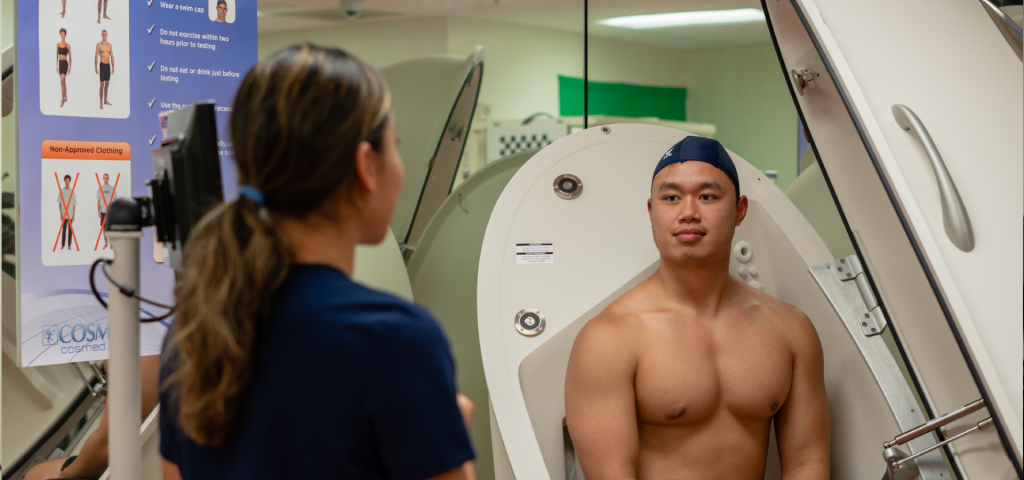
Air displacement plethysmography for the full lifespan — from newborns to adults, radiation-free.
What is air displacement plethysmography?
Air displacement plethysmography (ADP) is the modern, radiation-free successor to hydrostatic (underwater) weighing, and the Bod Pod is the clinical gold standard for this method. The system works on a simple physical principle: it measures your body mass on an integrated scale, then precisely measures your body volume by detecting the air displaced inside its sealed chamber, using the same pressure-volume relationship described by Boyle’s Law. Dividing mass by volume gives body density, and from density the system calculates your fat and fat-free mass in under five minutes — no radiation, no submersion.
ADP agrees with hydrostatic weighing to within 1% body fat on average and is validated for use across the full lifespan. The Shepherd Lab deploys the Bod Pod in the Shape Up studies — a multi-site NIH-funded research program examining body composition across ages and diverse Pacific populations.
What the Bod Pod measures
Total body fat % and Fat Mass (FM). Body density is converted to fat percentage using validated prediction equations, giving total fat mass and fat as a percentage of body weight. This is the same output as hydrostatic weighing but without the need for submersion, and it is far more accurate than BMI, which cannot distinguish fat from muscle. Fat % is the primary endpoint for monitoring dietary interventions, weight-loss programs, and metabolic health. Fields DA, Goran MI, McCrory MA. Body-composition assessment via air-displacement plethysmography in adults and children: a review. Am J Clin Nutr. 2002;75:453–467. doi:10.1093/ajcn/75.3.453
Fat-Free Mass (FFM). Everything in the body that is not fat: skeletal muscle, bone mineral, body water, and organs. FFM is as clinically important as fat mass — it determines how the body burns calories and responds to exercise. Monitoring FFM alongside fat mass distinguishes a healthy weight loss (fat lost, muscle preserved) from an unhealthy one (muscle lost along with fat), and tracks the anabolic response to resistance training or nutritional interventions.
Body Volume and Body Density. Body volume is measured directly, without any assumptions about body composition — making it one of the most physically grounded measurements in body-composition science. Volume combined with mass gives body density, the foundational quantity from which all other Bod Pod outputs are derived. Precise volume measurement is also why ADP is well-suited for populations where body habitus varies widely, including individuals with obesity, disability, or extreme muscularity.
Resting Metabolic Rate (RMR). RMR is the calories your body burns at rest to maintain basic physiological functions — breathing, circulation, brain activity, temperature regulation. The Bod Pod estimates RMR from your fat-free mass using validated equations, producing a personalized caloric baseline that reflects your body’s actual metabolic machinery rather than a generic age-height-weight formula. RMR is the foundation of any evidence-based nutrition plan.
Total Energy Expenditure (TEE). TEE adjusts your RMR upward based on your daily activity level, giving you your total daily calorie requirement for weight maintenance. The Bod Pod report provides this estimate directly, letting you set precise targets for weight loss, gain, or maintenance without relying on population-average estimates.
Progress tracking across visits. Because ADP is fast, radiation-free, and highly reproducible, it is well-suited for longitudinal monitoring. Serial Bod Pod results let you track the composition of your weight change over time — whether you are pursuing fat loss, muscle gain, or metabolic health — and give you feedback that a scale alone cannot. Toombs RJ, Ducher G, Shepherd JA, De Souza MJ. The impact of recent technological advances on the trueness and precision of DXA to assess body composition. Obesity. 2012;20:30–39. doi:10.1038/oby.2011.211
A system for every age — newborns to adults
One of the most distinctive capabilities of the Body Composition Lab is continuous lifespan coverage using air displacement plethysmography. We operate three instruments in the same ADP family, allowing body composition to be tracked with the same underlying physical principle from the day of birth through adulthood.
Pea Pod — infants from birth to 6 months (up to ~10 kg)
The Pea Pod is an infant-specific ADP system designed for babies from birth through approximately six months of age. The infant lies in a small, thermally controlled enclosure that maintains a stable environment throughout the measurement. The system accommodates typical infant behaviors — including movement and crying — and uses a HEPA-filtered chamber with integrated CO₂ monitoring and temperature control that meets incubator safety standards. A complete session takes approximately seven minutes.
The Pea Pod measures fat mass, fat-free mass, and fat percentage in newborns and young infants, producing body-composition data that no other practical clinical method can provide at this age. Body weight and body-fat percentage in the first months of life are strong predictors of later metabolic disease, growth trajectory, and neurodevelopmental outcomes. The Pea Pod is used in neonatal nutrition research, breastfeeding adequacy studies, assessment of intrauterine growth restriction, and early-life obesity prevention programs.
The system uses age- and sex-specific estimates of fat-free mass density, accounting for the rapid changes in body water and mineral content that occur during early development, and has been validated against the four-compartment model in healthy full-term and moderately premature infants. Ellis KJ, Yao M, Shypailo RJ, Urlando A, Wong WW, Heird WC. Body-composition assessment in infancy: air-displacement plethysmography compared with a reference 4-compartment model. Am J Clin Nutr. 2007;85:90–95. doi:10.1093/ajcn/85.1.90 Urlando A, Dempster P, Aitkens S. A new air displacement plethysmograph for the measurement of body composition in infants. Pediatr Res. 2003;53:486–492. doi:10.1203/01.pdr.0000049669.74793.e3
Tod Pod chair — toddlers and young children ages 2–6 years
The transition from infant to adult body-composition measurement has historically been one of the most challenging gaps in pediatric research: children older than six months are too large and active for the Pea Pod, but most children under age six cannot yet sit still or follow instructions well enough for the standard adult Bod Pod. The Tod Pod chair — the COSMED Pediatric Option for the Bod Pod — closes this gap with a custom, secured seat that allows children two to six years of age to be measured safely using the same ADP principles as the adult system.
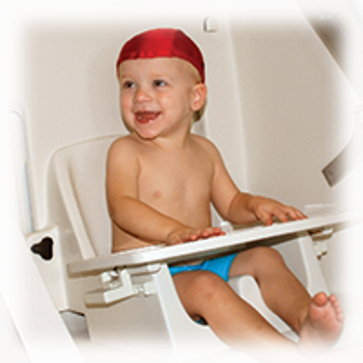
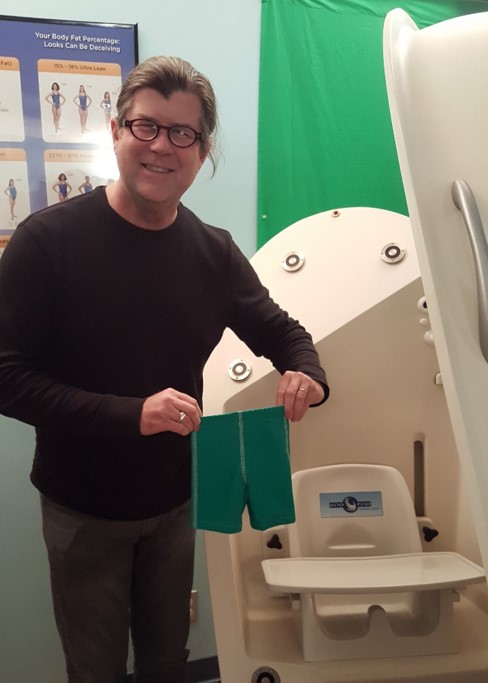
Body composition in the toddler and preschool years is increasingly recognized as a critical window for metabolic programming. Early adiposity trajectories in this age range predict cardiometabolic risk in adolescence and adulthood. The Tod Pod provides the only practical radiation-free method for quantifying fat and fat-free mass in this age group, making it a key tool in pediatric obesity research, early-childhood nutrition studies, and growth monitoring in clinical populations.
The Pediatric Option has been validated against the four-compartment model as the criterion method in children two to six years of age, and was shown to accurately estimate percentage body fat in this population. Fields DA, Allison DB. Air-displacement plethysmography pediatric option in 2–6 year olds using the four-compartment model as a criterion method. Obesity. 2012;20:1732–1737. doi:10.1038/oby.2012.28
Bod Pod — children age 6 through adulthood
For children six and older through adulthood, the standard Bod Pod applies. The Shepherd Lab’s Shape Up Keiki study (NIH/NICHD R01 HD103885) deploys the full ADP system across pediatric ages in Hawaiʻi, building body-composition reference data for multiethnic populations including Native Hawaiian and Pacific Islander children who are underrepresented in existing reference standards. The Bod Pod is also used in the Shape Up Adults study to characterize the lifespan trajectory of body composition in diverse Pacific populations. Zemel BS, Shepherd JA, Grant SFA, Lappe JM, Oberfield SE, Mitchell JA, Winer KK, Kelly A, Kalkwarf HJ. Reference ranges for body composition indices by dual energy X-ray absorptiometry from the Bone Mineral Density in Childhood Study Cohort. Am J Clin Nutr. 2023;118:792–803. doi:10.1016/j.ajcnut.2023.08.006
Taken together, the Pea Pod, Tod Pod chair, and Bod Pod give the BCL an unbroken chain of body-composition measurement from the first day of life through old age, using the same foundational physical principles at every stage.
How should I prepare for a Bod Pod scan?
- Avoid heavy exercise for 12–24 hours before the assessment.
- Avoid eating a large meal beforehand; when possible, fast for about 2–3 hours before the test.
- Arrive normally hydrated. Do not intentionally dehydrate or over-hydrate.
- Wear minimal, tight-fitting clothing. Examples: compression shorts, swimsuit, sports bra, and compression shorts, form-fitting spandex clothing.
What can I expect during the scan?
You will be provided a swim cap and will sit inside the BOD POD chamber for a series of brief measurements. The door will close during each measurement, but the chamber has a window, and staff will be nearby throughout the test. You will be asked to sit still, breathe normally, and avoid talking or moving while the measurement is being taken. Each measurement usually lasts less than a minute. You will also complete a short breathing measurement.