
Muscle Dynamometer
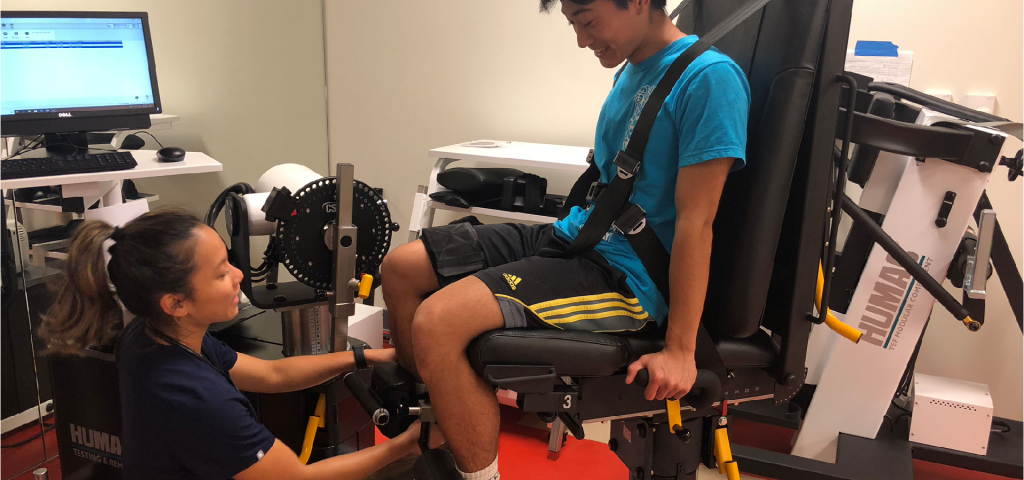
The muscle dynamometer measures the strength and power of different muscle groups and joints.
What is a muscle dynamometer?
A dynamometer is a device that measures the force produced by a muscle or muscle group during a controlled movement. The research-grade isokinetic dynamometer at the BCL constrains the speed of movement (isokinetic), fixes the limb in place (isometric), or controls external resistance through a range of motion (isotonic and passive), and records the resulting torque, power, and work output at high temporal resolution throughout the test. The result is a complete mechanical characterization of muscle performance — not just a peak number, but the full force-velocity curve, the eccentric-to-concentric ratio, left-right asymmetry, fatigue resistance across repeated contractions, and the passive stiffness and range of motion of the joint.
No other body-composition or physiology tool in the BCL produces this kind of information. DXA, BIA, and 3DO tell you how much muscle you have and where it is. The dynamometer tells you what that muscle can actually do.
Muscle strength is independently associated with all-cause mortality, cancer survival, metabolic disease risk, and functional independence in aging — above and beyond what body composition alone predicts. Grip strength is one of the strongest single predictors of cardiovascular mortality in large epidemiological studies. Leg-extension power is the primary determinant of mobility and fall risk in older adults. Isokinetic dynamometry is the gold standard for measuring all of these outcomes with the precision required for clinical research endpoints.
The BCL uses a research-grade isokinetic dynamometer system. Practically all major muscle groups in the body can be tested. The most common configurations for research protocols are described below.
Major tests and clinical indices
Grip strength (handgrip dynamometry). Grip strength is the most widely used single measure of overall muscle function in epidemiology and clinical research. It is a component of every major sarcopenia diagnostic framework — including the European Working Group on Sarcopenia (EWGSOP2) and the Asian Working Group for Sarcopenia (AWGS) — and is an entry-level screening criterion in clinical practice guidelines. Low grip strength predicts incident disability, hospitalization, cancer-treatment toxicity, frailty, and all-cause mortality independently of age, body weight, and body composition. Grip is measured bilaterally and compared against sex- and age-matched normative data. Cruz-Jentoft AJ, et al. Sarcopenia: revised European consensus on definition and diagnosis. Age Ageing. 2019;48:16–31. doi:10.1093/ageing/afz046
Leg extension strength and power (isokinetic knee extension/flexion). Knee-extensor (quadriceps) and flexor (hamstring) strength measured isokinetically across a range of test speeds is the standard endpoint for lower-extremity muscle function in aging research, rehabilitation, and sports physiology. Peak torque, peak power, and the hamstring-to-quadriceps ratio provide distinct clinical information: peak torque reflects absolute strength capacity, peak power reflects the ability to generate force rapidly (fall prevention), and the H:Q ratio flags injury risk and muscle balance asymmetry. The test is performed at standardized angular velocities (typically 60 and 180 degrees per second for strength and power protocols respectively) with bilateral comparison. Goodpaster BH, et al. The loss of skeletal muscle strength, mass, and quality in older adults: the health, aging and body composition study. J Gerontol A Biol Sci Med Sci. 2006;61:1059–1064. doi:10.1093/gerona/61.10.1059
Abdominal compression strength (trunk flexion). Trunk-flexor strength reflects the functional integrity of the core musculature, which is central to posture, mobility, load transfer, and protection of the lumbar spine. Isokinetic trunk-flexion testing is used in rehabilitation research, cancer-survivor functional assessments, and occupational health studies where core endurance is a clinical endpoint. Trunk strength is particularly relevant in cancer populations because abdominal and core muscles are disproportionately affected by sarcopenia, deconditioning from treatment, and surgical recovery.
Peak torque, peak power, and total work. Every dynamometer test reports the full torque-angle and torque-velocity profile across the movement. Peak torque is the maximum force-producing capacity at a given speed. Peak power (torque × angular velocity) is the rate of force development — the functional correlate of explosive movement and fall recovery. Total work integrates force across the full range of motion and reflects muscular endurance across the test repetitions. All three are available for every muscle group tested.
Eccentric-to-concentric ratio and fatigue index. Isokinetic testing captures both the concentric (shortening) and eccentric (lengthening) phase of each contraction. The eccentric-to-concentric ratio is an index of muscle control and neuromuscular quality that is abnormal in injury, deconditioning, and neurological disease. The fatigue index measures the decline in peak torque across a series of repeated contractions and quantifies muscular endurance independent of peak strength.
Bilateral asymmetry index. All major tests are performed bilaterally, and the dynamometer computes the percent asymmetry between dominant and non-dominant limbs. Asymmetry above 10–15% is a risk factor for musculoskeletal injury in athletes and a marker of unilateral functional impairment in clinical populations. Longitudinal tracking of asymmetry is used to monitor rehabilitation progress after unilateral injury or surgery.
Passive range of motion and stiffness. In passive mode, the dynamometer moves the limb at a controlled velocity with no voluntary muscle contraction and records the resistance of the joint and surrounding soft tissue. This measures passive range of motion and tissue stiffness independently of muscle strength — particularly useful in post-surgical recovery, joint disease, and contracture assessment.
Muscle groups we test
The dynamometer can be configured for practically every major joint and muscle group in the body. Common research configurations at the BCL include:
Grip strength (bilateral) · Knee extension and flexion (quadriceps and hamstrings) · Trunk flexion and extension (abdominal and back extensors) · Shoulder rotation and abduction · Hip extension and flexion · Ankle plantar and dorsiflexion · Elbow flexion and extension.
If your study requires a configuration not listed here, contact the lab to discuss protocol design and setup requirements.
Who benefits
Researchers. Isokinetic dynamometry is the accepted gold standard for strength endpoints in NIH-funded clinical trials, aging studies, cancer-survivor research, rehabilitation science, and sports physiology. The BCL dynamometer has been used as the criterion strength method in the Da Kine Study comparison of body-composition techniques, establishing the relationship between BIA, DXA, 3DO, and functional muscle capacity. Cataldi D, Bennett JP, Wong MC, et al. Accuracy and precision of multiple body composition methods and associations with muscle strength in athletes of varying hydration: The Da Kine Study. Clin Nutr. 2024;43:189–199. doi:10.1016/j.clnu.2023.11.040
Community members and athletes. Strength testing gives you an objective baseline for your training program, identifies left-right imbalances before they become injuries, tracks the effectiveness of a training or rehabilitation intervention, and provides age- and sex-matched percentile ranking for your muscle function relative to normative data. Unlike most gym-based testing, isokinetic dynamometry isolates each muscle group from compensatory movement and provides a reproducible measurement you can return to at any interval.
Cancer patients and survivors. Sarcopenia — the progressive loss of skeletal muscle mass and strength — is prevalent in cancer patients across treatment stages and is an independent predictor of treatment toxicity, surgical complications, quality of life, and survival. Measuring both muscle mass (DXA or BIA) and muscle strength (dynamometry) together is required by current international sarcopenia diagnostic criteria and provides the most complete picture of muscle health available.
How should I prepare for a muscle dynamometer assessment?
Wear comfortable clothing that will not restrict your leg movements.
What can I expect?
You will be positioned and secured in the dynamometer based on which joint is being evaluated. Depending on the protocol, each test takes about 15–20 minutes.