
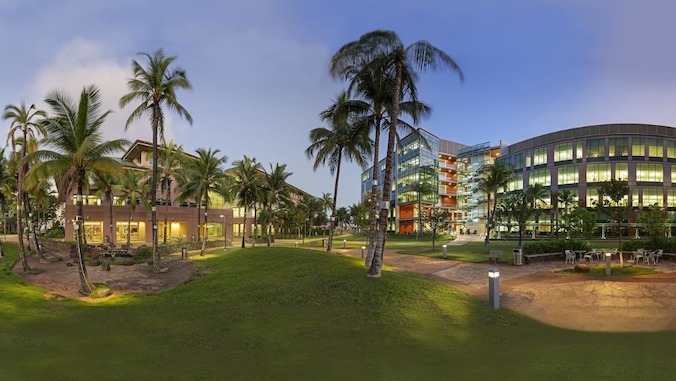
More than $12 million in federal funding from the National Institutes of Health will establish the Pacific Center for Artificial Intelligence and Data Science in Medicine (PAC-AID) — a five-year effort by the University of Hawaiʻi Cancer Center and the John A. Burns School of Medicine (JABSOM) to build the region’s first dedicated medical-AI infrastructure and put it to work on the health problems that matter most in Hawaiʻi and across the Pacific.
The award comes through the NIH’s Centers of Biomedical Research Excellence (COBRE) program, administered by the National Institute of General Medical Sciences. The grant runs through February 2031.
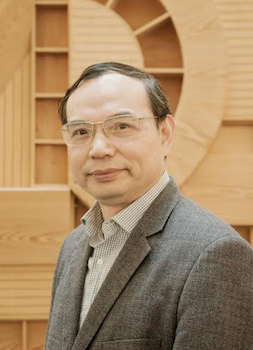
John Shepherd, the Cancer Center’s chief scientific officer and B.H. and Alice C. Beams Endowed Professor in Cancer Research at JABSOM, will co-lead PAC-AID with Youping Deng, a JABSOM cancer researcher and director of the medical school’s Bioinformatics Core Facility.
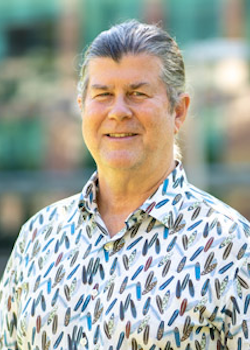
“This COBRE award provides the critical infrastructure to bridge advanced AI computational methods with our specific clinical and community health challenges.”
— John Shepherd, co-principal investigator, PAC-AID
A garage-sized data center with a Pacific-sized mission
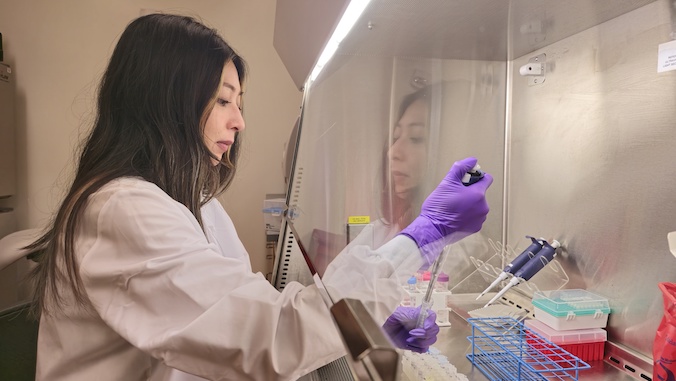
Work is already under way to convert a garage-sized, air-conditioned, ground-floor room at the Cancer Center into Hawaiʻi’s first-of-its-kind AI data center — the Medical AI Core (MedAI Core). Roughly $300,000 of the federal funds will renovate and outfit the room with high-speed computing equipment, with the goal of bringing it online by the end of the year. When complete, the center is expected to employ about 26 people with backgrounds primarily in computer science and programming.
Crucially, this is not a warehouse-scale facility. “It’s going to be much smaller. It’s not going to be anything like that,” U.S. Sen. Brian Schatz said when asked whether residents should worry about an Amazon-sized data center landing in the islands. JABSOM spokesperson Matthew Campbell agreed the project will not require “massive infrastructure with massive servers that use massive energy.”
Why Hawaiʻi-specific data matters
Existing AI medical databases already let clinicians, for example, photograph a suspicious mole for AI analysis instead of removing it for a potentially unnecessary biopsy. But those models are trained predominantly on continental US and European — and largely light-skinned — populations, and they don’t capture the diversity found across Hawaiʻi and the Pacific.
“Existing AI data doesn’t account for the differences among various ethnic backgrounds found in Hawaiʻi and around the Pacific region.”
— John Shepherd
More detailed data on the differences between Filipino, Korean, Japanese, and Chinese patients — rather than lumping them under a single “Asian” umbrella — could sharpen diagnosis and treatment for conditions including skin cancer. Data gathered by UH researchers could in turn be accessed by clinicians on the mainland and across the Pacific to better distinguish between individual ethnic groups.
That ambition connects directly to the lab’s ongoing work on the Hawaiʻi and Pacific Islands Mammography Registry (HIPIMR), through which Shepherd is developing AI biomarkers to predict cancer risk for Asian and Pacific Islander populations.
Four research projects, more than ten pilots
Alongside the MedAI Core, PAC-AID will fund four inaugural research projects and support a pilot program of more than ten studies addressing locally relevant health challenges:
- Kevin Cassel (UH Cancer Center) — AI-driven full-body imaging to triage skin lesions
- Elizabeth Nakasone (UH Cancer Center) — pancreatic cancer in Native Hawaiian and Japanese populations
- Jonathan Huang (UH Mānoa, Public Health) — modeling the effects of environmental toxicants on fetal development
- Yiqiang Zhang (JABSOM) — identifying genetic traits in congenital heart disease
“By the end of this project, we expect to have a nationally competitive Medical AI Core, four independently funded research leaders, and more than 10 pilot projects.”
— Youping Deng, co-principal investigator, PAC-AID
A catalyst for Hawaiʻi research
Sen. Schatz, who pushed for the funding, called the project “very good news for Hawaiʻi and the Cancer Center and School of Medicine,” and said there is “not a comparable research institution in the Pacific.”
“The quality of the research and the sophistication of the research and the size of the grant means that Hawaiʻi is going to lead in this space for years,” Schatz said. He estimated the new center could ultimately catalyze an additional $50 million to $100 million in research funding. Shepherd’s own projection is more conservative but still substantial: if six investigators go on to win independent NIH R01 awards, that alone would bring roughly $19.5 million in further federal research dollars to the state.
UH leaders framed the award as a milestone for the university’s research mission. Incoming UH Mānoa Chancellor Vassilis Syrmos called PAC-AID “a vital expansion of that mission, enabling our faculty to harness the power of artificial intelligence to pioneer new avenues of biomedical inquiry.” Cancer Center Director Naoto T. Ueno said the funding “will substantially strengthen AI and data science capabilities and support the development of the next generation of investigators,” and JABSOM Dean Sam Shomaker said it “will help accelerate discoveries that address the real health challenges facing our communities.”
Schatz also acknowledged the broader stakes: “AI has enormous potential in the healthcare space. But there are also very significant risks in terms of fraud and theft, in terms of cybersecurity, in terms of energy and water use and in terms of what happens to employment.”
Meeting the wave
For Shepherd, 63, the work is also personal. He called AI “a young man’s game,” then added: “But I really want to stay in the game. I want to stay relevant.”
He likened the arrival of AI to a tsunami — invoking John Papa ʻĪʻī, who helped bridge Hawaiian royalty and the missionaries and warned of the flood of newcomers to come. “AI is a lot like that. It’s a literal tsunami, and we can either choose to ignore it and have it impact us in a random way, or we can choose how we’re going to meet it so that it serves us.”
If Hawaiʻi ever does need larger AI infrastructure, Shepherd argued, it should be built on the islands’ own terms: “We’ve got plenty of sun, we’ve got plenty of chill water in the ocean. We’ve got the volcano for power. We’ve got wind. … We would need to figure out a way for us to do it using our own local resources.”
Coverage of the PAC-AID award appeared in the Honolulu Star-Advertiser (Dan Nakaso, June 21, 2026), UH News, and Hawaii News Now. Photos courtesy University of Hawaiʻi.